THE WALDECK LAB
  • Home
  • People
    • Professor Waldeck
    • Group Members
    • Alumni
  • Research
    • The CISS Effect
    • Fundamental Studies of CISS
    • Spin Control of Chemical Reactions
    • Synthesis of Chiral Materials
  • Publications
  • Teaching
  • Join us

Spin Control of Chemical Reactions

Group Members: Brian P. Bloom, Wiley A. Dunlap-Shohl, Mohammed Fiham, Meera Joy, Aravind Vadakkayil
​
Collaborators: Ron Naaman (Weizmann Institute of Science), L. Robert Baker (The Ohio State University), Carmen Herrmann (University of Hamburg)
 
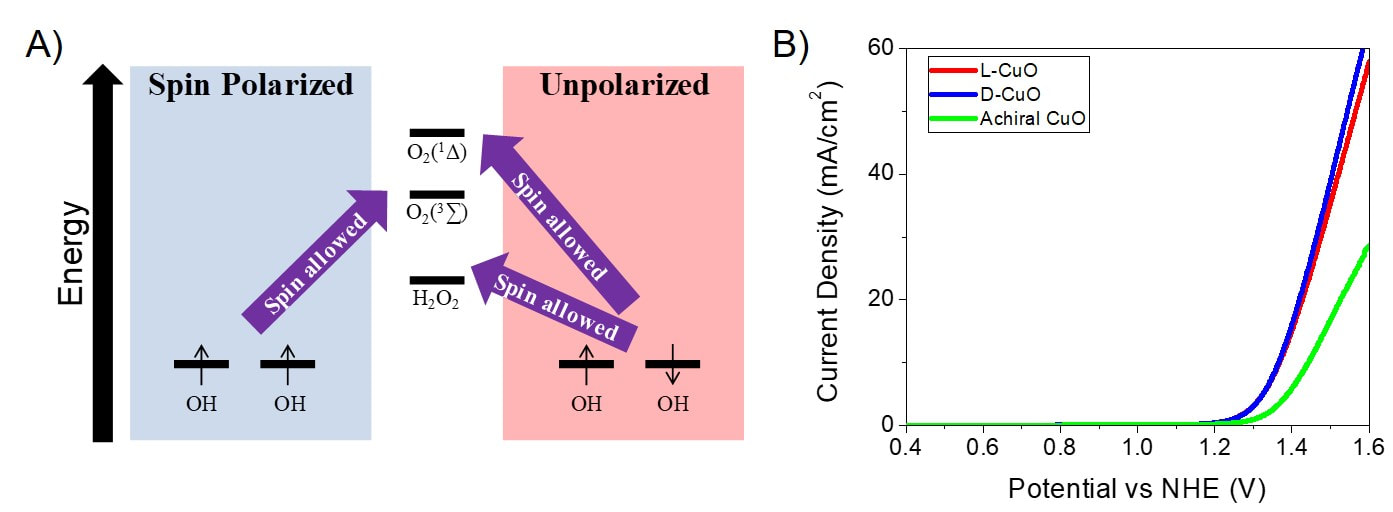
The control and manipulation of chemical processes has traditionally been performed through modulation of ‘classical’ parameters such as temperature, catalyst identity, bias voltage, etc. In this project however, we are showing that control over the electron spin can strongly influence chemical reactions. Our research demonstrates that spin-polarized catalysts can be used to discriminate between triplet and singlet reaction pathways and offers new strategies for enantiomeric discrimination in chemical reactions.

Inherently Chiral Catalysts
Current efforts in our group are exploring how the CISS effect can be used to improve the efficacy of the oxygen evolution reaction (OER) in water splitting. The figure below (left) shows a cartoon describing the mechanism; spin alignment of reaction intermediates at the catalyst surface (blue) promote triplet oxygen formation and suppress singlet mediated by-product formation, compared to catalysts with disordered spin alignment (orange). The figure on the right demonstrates implementation of this effect for FexCo3-xO4 catalysts. When the catalysts are chiral (solid line) a lower reaction overpotential, i.e. higher current response at a given voltage, is observed compared to when the catalysts are achiral (dashed line).
Picture
Chiral Bias Acting on Achiral Catalysts
In addition to coating catalysts with chiral molecules or synthesizing chiral catalysts, we are also investigating alternative strategies for achieving spin-polarized catalysis. The figure below shows linear sweep voltammograms of IrO2, RuO2, and Fe0.7Co2.3O4 catalyst films with molecular additives (camphor sulfonic acid) to the conductive Nafion binder support. When an enantiopure additive is used (blue) a lower reaction overpotential, i.e. higher current response at a given voltage, is observed compared to catalyst films prepared with racemic mixtures of additives (red) or without additives (black). We attribute the improved performance to the chiral molecules acting as a local chiral bias that spin-polarize reaction intermediates on the catalysts.

Picture
Recent publications for spin controlled electrocatalysis:
5. Vadakkayil, A.; Dunlap-Shohl, W. A.; Joy, M.; Bloom, B. P.; Waldeck, D. H.  Improved Catalyst Performance for the Oxygen Evolution Reaction Under a Chiral Bias ACS Catalysis 2024, 14, 17303.

4. Gajapathy, H.; Bandaranayake, S.; Hruska, E.; Vadakkayil, A.; Bloom, B. P.; Londo, S.; McClellan, J.; Guo, J.; Russell, D.; de Groot, F. M. F.; Yang, F.; Waldeck, D. H.; Schultze M.; Baker, L. R. Spin polarized electron dynamics enhance water splitting efficiency by yttrium iron garnet photoanodes: a new platform for spin selective photocatalysis Chem. Sci. 2024, 15, 3300.

3. Vadakkayil, A.; Clever, C.; Kunzler, K. N.; Tan, S.; Bloom, B. P.; Waldeck D. H. Chiral Electrocatalysts Eclipse Water Splitting Metrics through Spin Control Nat. Commun. 2023, 14, 1067.

2. Sang, Y.; Tassinaria, F.; Santra, K.; Zhang, W.; Fontanesi, C.; Bloom, B. P.; Waldeck, D. H.; Fransson, J.; Naaman, R.; Chirality Enhances Oxygen Reduction Proc. Natl. Acad. Soc. USA 2022, 119, e2202650119.

1. Ghosh, S.; Bloom, B. P.; Lu, Y.; Lamont, D.; Waldeck, D. H. Increasing the Efficiency of Water Splitting through Spin Polarization using Cobalt Oxide Thin Film Catalysts J. Phys. Chem. C 2020, 124, 22610.
  • Home
  • People
    • Professor Waldeck
    • Group Members
    • Alumni
  • Research
    • The CISS Effect
    • Fundamental Studies of CISS
    • Spin Control of Chemical Reactions
    • Synthesis of Chiral Materials
  • Publications
  • Teaching
  • Join us